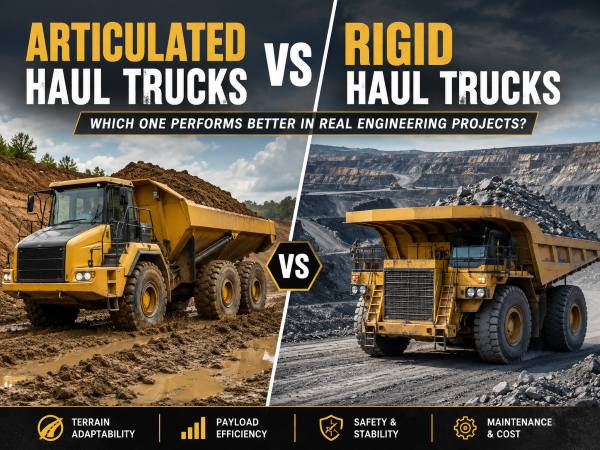
On large earthmoving projects, the debate between articulated haul trucks and rigid haul trucks usually starts long before equipment arrives on site.
At first glance, both machines are designed to move massive amounts of material. But once they enter real operating conditions—muddy haul roads, quarry slopes, unstable terrain, or long-distance transport routes—the differences become much more obvious.
Choosing the wrong hauling equipment doesn’t just affect transport speed. It changes fuel consumption patterns, cycle efficiency, maintenance pressure, and even overall project productivity.
In practice, the decision between an articulated haul truck and a rigid haul truck is less about “which machine is better” and more about which machine matches the environment it actually has to survive in.
Why This Comparison Matters More Than Most Fleet Managers Expect
In engineering operations, hauling equipment is often one of the highest-utilization assets on site. A mismatch between machine design and working conditions can quickly lead to:
- unstable hauling cycles
- excessive tire wear
- reduced traction under load
- drivetrain stress
- inefficient fuel usage
- increased downtime during wet conditions
This is why experienced site managers evaluate hauling equipment based on terrain behavior and operational consistency—not just payload figures.
The Structural Difference Changes Everything
The most important distinction between these two machines is frame design.
A rigid haul truck uses a single fixed chassis structure. The cab and dump body sit on one continuous frame. This creates high structural strength and allows the truck to carry extremely heavy payloads efficiently on stable haul roads.
An articulated haul truck, by contrast, uses a pivot joint between the cab and rear body. The machine effectively bends in the middle during steering and terrain movement. This articulation dramatically improves flexibility and traction on rough or unstable surfaces.
That one engineering difference completely changes how the machine behaves under load.
Where Articulated Haul Trucks Perform Better
In real construction and earthmoving environments, articulated haul trucks are usually preferred when terrain conditions are unpredictable.
Typical environments include:
- muddy construction zones
- soft soil excavation areas
- uneven quarry access roads
- steep switchback haul paths
- temporary infrastructure projects
Because the chassis can articulate independently, the wheels maintain better ground contact across uneven surfaces. That translates into improved traction and more stable movement under load.
Operators also notice that articulated haul trucks maintain control more naturally when navigating tight turns or unstable haul routes.
This is one reason articulated trucks are commonly seen on infrastructure and road construction projects where conditions change constantly.
Why Rigid Haul Trucks Still Dominate Large Mining Operations
Rigid haul trucks remain dominant in high-production mining environments for one reason: efficiency at scale.
A rigid structure provides:
- higher payload capability
- stronger frame rigidity
- more stable high-speed hauling
- better efficiency on maintained haul roads
In large mining sites with engineered haul routes, rigid haul trucks usually outperform articulated models in total material moved per cycle.
They are especially effective when:
- haul distances are long
- road surfaces are maintained
- turning radius is less critical
- production targets prioritize maximum volume
This is why many quarry and mining operations continue using rigid haul trucks despite the flexibility advantages of articulated models.
Maneuverability Is Often the Real Deciding Factor
Payload attracts attention, but maneuverability often determines actual efficiency.
Articulated haul trucks are significantly better in confined or technically difficult jobsite layouts because the articulation joint allows tighter movement angles.
This matters more than many buyers initially expect.
In projects with:
- limited turning space
- temporary haul roads
- changing excavation layouts
- unstable working platforms
reduced maneuverability quickly slows cycle times.
Rigid haul trucks perform best when routes are predictable and open. Articulated trucks perform best when movement flexibility matters more than maximum haul volume.
Traction and Ground Contact Under Load
From an engineering perspective, traction behavior is one of the biggest operational differences.
Articulated haul trucks distribute movement more dynamically across uneven terrain. This helps maintain wheel contact during off-road operation.
Rigid haul trucks, however, are optimized for stability on prepared surfaces rather than terrain adaptability.
In wet or unstable conditions, articulated systems usually maintain movement efficiency more consistently. This directly affects:
- cycle completion time
- fuel efficiency under load
- tire wear rate
- drivetrain stress
On poorly maintained haul roads, this difference becomes very noticeable.
Fuel Efficiency Depends on the Jobsite, Not Just the Machine
There is no universally “more fuel-efficient” option.
Fuel behavior changes depending on:
- haul distance
- terrain resistance
- payload consistency
- road condition
- idle time during cycles
Rigid haul trucks tend to achieve better efficiency on long, stable haul roads because their structure minimizes energy loss during movement.
Articulated haul trucks, however, often outperform rigid models in unstable terrain because they maintain traction more effectively and avoid unnecessary wheel slip.
In real operations, matching the machine to terrain matters more than theoretical fuel figures.
Maintenance Reality in Harsh Engineering Conditions
Both machine types experience heavy mechanical stress, but the stress points differ.
Articulated Haul Truck Maintenance Focus
Operators usually monitor:
- articulation joint wear
- hydraulic steering systems
- suspension movement points
- center pivot lubrication
Rigid Haul Truck Maintenance Focus
Attention is typically placed on:
- frame fatigue
- suspension stress
- drivetrain load handling
- brake system thermal management
Maintenance strategy depends heavily on operating environment and haul intensity.
Which Machine Fits Which Project?
The answer usually becomes clear when looking at actual site conditions.
| Working Environment | Better Choice |
|---|---|
| Soft or muddy terrain | Articulated haul truck |
| Large open-pit mining | Rigid haul truck |
| Tight maneuvering space | Articulated haul truck |
| Long haul routes | Rigid haul truck |
| Temporary construction roads | Articulated haul truck |
| High-volume quarry transport | Rigid haul truck |
This is why many large contractors operate both types depending on project phase and terrain condition.

What Experienced Operators Usually Prioritize
Interestingly, experienced operators rarely choose based on payload alone.
Instead, they focus on:
- traction consistency
- stability under load
- predictable handling
- downtime frequency
- terrain adaptability
Because in real engineering work, a machine that moves consistently often outperforms a machine with higher theoretical capacity but unstable field performance.
Final Thoughts
The difference between articulated haul trucks and rigid haul trucks is fundamentally a difference in engineering philosophy.
Rigid haul trucks prioritize structural efficiency and maximum production on stable haul roads.
Articulated haul trucks prioritize terrain adaptability, maneuverability, and operational flexibility under unpredictable conditions.
The most effective equipment choice depends less on specifications and more on how the machine behaves in the actual environment where it will work.
For engineering projects, real productivity usually comes from matching machine design to terrain reality—not simply selecting the largest hauling capacity available.