Most people assume payload capacity is just a number on a specification sheet.
But in real construction or mining work, things are rarely that simple.
Two dump trucks with the same rated capacity can behave completely differently once they enter a jobsite. One handles full loads smoothly all day. The other struggles on slopes, overheats, or wears out faster than expected.
So what actually defines dump truck payload capacity in real operation? It’s not just about how much weight a manufacturer claims—it’s about how the entire system works together under stress.
Payload Capacity Is Not Just “How Much It Can Hold”
On paper, payload capacity looks straightforward: maximum load the truck can carry safely.
In practice, operators quickly realize that real-world dump truck payload capacity depends on multiple interacting factors:
- chassis strength
- axle configuration
- engine torque output
- transmission efficiency
- suspension stability
- braking system capability
When any one of these systems is mismatched, the “rated capacity” becomes less meaningful in real operation.
That’s why experienced fleet managers rarely judge a truck by a single number.
Why Two Trucks With the Same Capacity Perform Differently
This is where real jobsite experience matters.
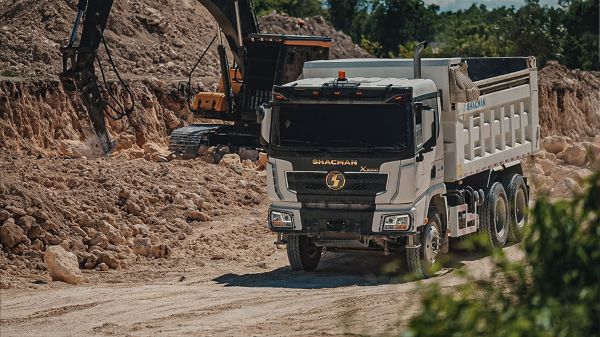
A truck working in a quarry with steep ramps will behave very differently from a truck hauling on relatively flat construction roads—even if both are labeled with the same dump truck payload capacity.
For example:
- One truck may maintain speed while fully loaded
- Another may slow down significantly on uphill segments
- One may complete cycles consistently
- Another may require frequent cooling breaks
The difference usually comes down to power delivery and structural balance, not just payload rating.
The Hidden Role of Axles and Load Distribution
If there is one system that quietly defines real dump truck payload capacity, it is the axle setup.
Axles don’t just carry weight—they distribute it.
A well-designed configuration ensures:
- even tire loading
- stable braking performance
- reduced frame stress
- better traction on uneven ground
Poor load distribution, even within rated capacity, can shorten equipment life significantly.
This is why 6×4 and 8×4 configurations are often chosen for heavy-duty environments—they don’t necessarily increase theoretical capacity, but they make real capacity usable.
Engine Torque: The Factor Most People Underestimate
Payload capacity is meaningless if the truck cannot move the load efficiently.
A dump truck payload capacity rating assumes the engine can deliver sufficient torque at low speed.
In real operation, torque determines:
- whether the truck can start moving under full load
- how it behaves on uphill sections
- whether it maintains stability during acceleration
This is also why diesel engines dominate this segment—they deliver usable torque where it matters most.
Suspension: The Difference Between “Rated” and “Usable” Capacity
Suspension is often overlooked in payload discussions, but it directly affects how safely a truck carries weight.
A strong suspension system ensures that the dump truck payload capacity is not just theoretical, but operationally stable.
In rough terrain, suspension determines:
- vibration control under load
- stability during turning
- frame protection from impact stress
- driver control consistency
Without proper suspension support, payload capacity becomes limited by comfort and safety rather than structural rating.
Real-World Limiting Factors Operators Actually Face
In daily operations, payload is often limited not by engineering specs, but by working conditions.
Common real constraints include:
- road surface quality
- slope angle
- material density (wet vs dry load)
- cycle distance
- braking performance under load
This is why experienced operators often adjust actual load below rated dump truck payload capacity to maintain efficiency and reduce wear.
When Higher Capacity Doesn’t Mean Better Productivity
It’s tempting to think higher capacity always improves efficiency. But in real jobsite conditions, that’s not always true.
If a truck is overloaded relative to terrain or drivetrain capability:
- cycle time increases
- fuel consumption rises
- brake and tire wear accelerates
- downtime becomes more frequent
In many cases, optimal performance comes from matching load to working conditions—not maximizing dump truck payload capacity on paper.
Maintenance and Payload Relationship
There’s a direct relationship between maintenance condition and usable capacity.
Even within rated limits, poor maintenance reduces safe operating payload due to:
- weakened suspension performance
- reduced braking efficiency
- engine strain under load
- transmission overheating
A well-maintained truck consistently performs closer to its rated dump truck payload capacity, while a poorly maintained one effectively loses capacity over time.
How to Think About Payload in Real Operations
Instead of treating payload as a fixed number, experienced operators think of it as a range influenced by conditions.
A more practical mindset is:
- rated capacity = engineering maximum
- real capacity = jobsite-adjusted working load
- optimal capacity = balance of speed, safety, and durability
This approach leads to better long-term productivity than simply maximizing load per trip.
Conclusion
Dump truck payload capacity is not a single fixed value—it is the result of how engine power, axle design, suspension behavior, braking ability, and working conditions interact in real operation.
Understanding this helps operators move beyond specification-based decisions and focus on actual jobsite performance.
In heavy-duty environments, the best-performing truck is rarely the one with the highest number on paper—it is the one that maintains stable, repeatable performance under real working conditions.
FAQ
Is dump truck payload capacity fixed?
No. It varies depending on terrain, load type, and operating conditions.
Why do trucks with the same capacity perform differently?
Because engine torque, axle configuration, and suspension design affect real-world performance.
Can payload capacity be exceeded safely?
No. Overloading reduces safety and increases mechanical wear.
What affects payload performance the most?
Torque delivery, axle load distribution, and suspension stability.
How can payload efficiency be improved?
By matching load size to terrain conditions and maintaining the vehicle properly.