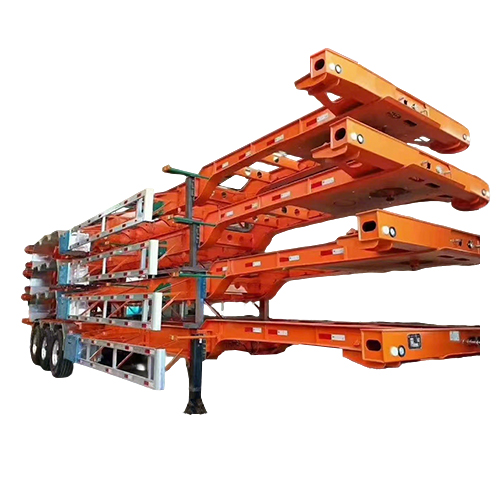
A skeleton semi trailer is built for one primary job: transporting containers efficiently between ports, yards, warehouses, rail terminals, and industrial sites. Compared with a flat deck trailer, the skeleton semi trailer uses a lighter frame layout with twist locks positioned for container sizes. For logistics companies and import-export operators, the benefit is lower unnecessary tare weight and faster container handling.
Haiyu supplies skeleton semi trailer options for container-focused fleets. Because container transport appears simple, some buyers underestimate specification details. A reliable skeleton semi trailer still needs the right frame strength, lock layout, axle system, braking compatibility, and tractor matching.
Why Container Fleets Use Skeleton Trailers
The biggest advantage of a skeleton semi trailer is purpose-built efficiency. It does not carry a full deck or side walls that are unnecessary for standard containers. This can reduce tare weight and simplify inspection. It also gives drivers clear access to twist locks and container positioning points.
A skeleton semi trailer is usually chosen by fleets that move containers repeatedly, not by operators who switch between many cargo types every day. If a fleet often carries loose goods, machinery, or palletized materials, a flatbed semi trailer may offer more flexibility.
Container Sizes and Twist Lock Layout
The first specification question is container size. Buyers should confirm whether the skeleton semi trailer will carry 20-foot, 40-foot, or mixed container loads. Twist lock location, rear overhang, and frame length should match the container plan. If mixed work is expected, the lock layout must support multiple positions without creating daily handling problems.
Container dimensions are standardized internationally, and the ISO container standard is a useful reference point for understanding why trailer lock layout must be precise. The skeleton semi trailer should support standard container handling practices in the target market.
Frame Design and Weight Efficiency
A skeleton semi trailer should be light enough for efficient container transport but strong enough for loaded operations over real roads. Buyers should review main beam height, steel grade, crossmember layout, welding quality, and reinforcement near twist lock positions. Concentrated stress around container corners makes frame design important.
Overly light construction can reduce service life on rough roads. Overly heavy construction can reduce payload efficiency. The best skeleton semi trailer specification balances route condition, container weight, and local axle rules.
Axle and Suspension Selection
Axle selection depends on legal payload, route surface, and maintenance preference. Three-axle layouts are common in many markets, while some regions require different axle spacing or suspension choices. Mechanical suspension is simple and durable; air suspension may improve ride quality when route conditions and service capacity support it.
The skeleton semi trailer braking system, lighting, tire size, and landing gear should match local regulations and the tractor truck. Buyers planning a complete set can review Haiyu tractor options such as the HOWO 6×4 tractor truck together with the trailer.
Port, Highway, and Yard Operation
Port work often involves frequent coupling, short trips, and tight turning spaces. Highway work involves higher speed, longer distance, and more attention to tire wear and braking stability. Yard operation requires durability under repeated loading cycles. A skeleton semi trailer for port shuttle work may not need the same specification as one used for long-distance inland container routes.
Buyers should describe the share of port, highway, and yard operation. This helps the manufacturer recommend landing gear, tire specification, suspension, and frame reinforcement that fit the actual duty cycle.
Buyer Specification Table
| Item | Buyer Decision | Reason |
|---|---|---|
| Container plan | 20 ft, 40 ft, or mixed | Controls frame length and lock positions |
| Twist locks | Quantity and layout | Prevents unsafe container movement |
| Frame strength | Steel grade and reinforcement | Supports loaded container corners |
| Suspension | Mechanical or air | Matches road quality and maintenance capability |
| Landing gear | Static load and duty cycle | Important for frequent container yard operation |
Common Mistakes in Trailer Selection
A common mistake is buying a skeleton semi trailer based only on container length. The buyer should also confirm container weight, loading equipment, route roughness, tractor height, and legal load limits. Another mistake is ignoring spare parts. Axles, brake parts, lights, tires, twist locks, and landing gear must be serviceable in the operating region.
How to Prepare an RFQ
A clear RFQ should include container sizes, maximum container weight, road condition, destination country, preferred axle brand, tire size, suspension type, and expected daily trips. If the skeleton semi trailer will operate in a port or terminal, mention turning space and coupling frequency.
Haiyu can help container transport buyers compare skeleton, flatbed, and cargo box trailer choices. Explore the product range or send your route and container data through Contact Us to discuss a skeleton semi trailer specification.
FAQ
What is a skeleton semi trailer used for?
It is used mainly for transporting shipping containers between ports, yards, warehouses, rail terminals, and industrial sites.
Can one trailer carry both 20 ft and 40 ft containers?
Yes, if the twist lock layout and frame are specified for mixed container work.
Is a skeleton trailer lighter than a flatbed?
Usually yes, because it is built around a frame rather than a full deck, but final weight depends on the exact design.
What should buyers check before ordering?
Check twist lock layout, frame strength, axle configuration, suspension, braking system, tire size, landing gear, and local road rules.
Can Haiyu match the trailer with a tractor truck?
Yes. Haiyu can discuss tractor and skeleton semi trailer matching for container logistics based on route and payload needs.