Buying a lowbed semi trailer is not simply a matter of choosing the highest payload rating. For contractors, equipment dealers, mining companies, logistics fleets, and project procurement teams, the correct specification depends on what machinery will be transported, how it will be loaded, local road conditions, axle regulations, and the tractor unit available.
A trailer that is oversized for the job can increase purchase cost and operating weight. A trailer that is underspecified may create loading problems, poor weight distribution, premature structural wear, or regulatory issues.
Before requesting a quotation, buyers should focus on several practical questions:
- What is the maximum weight of the equipment you need to transport?
- How wide, long, and tall is the machine in transport condition?
- How many axles are needed for the expected load?
- Will machinery drive onto the trailer or require crane loading?
- What deck height is suitable for local height restrictions?
- Are mechanical or air suspension systems better for the operating environment?
- Will the trailer regularly operate on highways, construction sites, mines, or rough roads?
This guide explains how to turn those questions into a practical lowbed semi trailer specification.
What Is a Lowbed Semi Trailer?
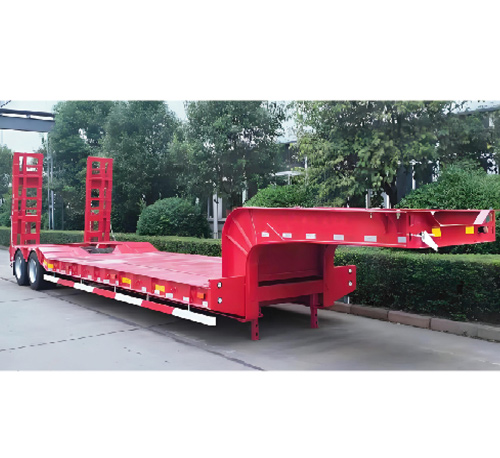
A lowbed semi trailer is a heavy-duty trailer designed with a loading platform positioned lower than that of a conventional flatbed trailer. The lower deck helps reduce the overall transport height and lowers the center of gravity of heavy machinery.
This design makes lowbed trailers particularly suitable for excavators, bulldozers, wheel loaders, road rollers, agricultural machinery, mining equipment, and oversized industrial machines.
Why Does Deck Height Matter?
Transport height is determined by both the machine itself and the height of the trailer deck.
A lower deck can reduce the combined height of the trailer and cargo, which is especially important when transporting excavators, crawler equipment, or machinery with tall cabins.
Lower deck height also helps maintain a lower center of gravity, which can improve stability when transporting heavy equipment.
Lowbed vs Standard Flatbed Trailer
A standard flatbed is generally more suitable for containers, steel, building materials, and cargo that does not require an especially low loading platform.
A lowbed semi trailer is more specialized. Its structure is optimized for heavy or tall machinery where loading angle, deck height, concentrated weight, and axle distribution are more important.
| Factor | Lowbed Semi Trailer | Standard Flatbed |
|---|---|---|
| Main use | Heavy machinery | General cargo |
| Deck height | Lower | Higher |
| Heavy equipment loading | Better suited | More limited |
| Tall machinery | More suitable | Higher total transport height |
| Loading ramps | Common | Less important |
| Concentrated loads | Heavy-duty designs available | Depends on configuration |
Start With the Equipment, Not the Trailer
One of the most common purchasing mistakes is asking a manufacturer:
“What is your standard 60-ton lowbed semi trailer?”
A better starting point is:
“What machinery does the trailer need to carry?”
The equipment should determine the trailer specification, not the other way around.
Record Maximum Machine Weight
Begin with the heaviest machine the fleet expects to transport.
Do not use only the nominal operating weight from a general product brochure. Actual transport weight may change depending on attachments, buckets, blades, counterweights, fuel, and optional equipment.
Leave a Practical Capacity Margin
A trailer should not normally be selected so that the expected cargo is constantly operating at the theoretical limit of the configuration.
A reasonable design margin can provide more flexibility for future equipment and help reduce excessive structural stress.
The final allowable load, however, must always be evaluated together with trailer tare weight, axle ratings, tires, suspension, tractor configuration, and local road regulations.
How Much Payload Does a Lowbed Semi Trailer Need?
Payload is one of the first specifications buyers compare, but it should never be considered independently.
Lowbed trailers may be configured for different transport requirements, from medium construction machinery to much heavier mining and project equipment.
A simplified purchasing reference may look like this:
| Equipment Example | Typical Buying Focus | Trailer Configuration to Evaluate |
|---|---|---|
| Small excavator | Maneuverability and loading | Lower-capacity lowbed |
| Medium excavator | Deck strength and axle load | 3-axle configuration |
| Bulldozer | Concentrated track load | Reinforced deck |
| Wheel loader | Width and total height | Low deck with ramps |
| Large excavator | Weight distribution | Multi-axle lowbed |
| Mining machinery | Extreme load and road conditions | Customized heavy-duty configuration |
These categories should be treated as starting points rather than fixed capacity rules. Actual equipment dimensions and weight should always be provided before the final trailer design is confirmed.
Payload Is Not the Same as GVW
Buyers should clearly distinguish between:
- trailer tare weight;
- rated payload;
- axle capacity;
- tire capacity;
- gross vehicle or combination weight.
A large number printed next to “capacity” does not automatically mean that the trailer can legally carry that load on every road.
The legal operating weight can depend on national or regional axle-load regulations, permits, tractor configuration, road classification, and cargo dimensions.
How Many Axles Should a Lowbed Semi Trailer Have?
Axle configuration is one of the most important decisions in lowbed trailer procurement.
Adding axles can distribute weight over more contact points, but more axles also increase trailer weight, complexity, tire count, maintenance requirements, and turning resistance.
2-Axle Lowbed Trailer
A 2-axle configuration may be considered for relatively lighter machinery or markets where maneuverability is particularly important.
It is generally not the first choice for very heavy construction or mining machinery.
3-Axle Lowbed Semi Trailer
The 3-axle configuration is widely used because it provides a practical balance between load distribution, cost, maintenance, and maneuverability.
For many excavators, loaders, bulldozers, and construction machines, a 3-axle lowbed semi trailer is an important configuration to evaluate.
4 Axles and More
Heavier machinery may require four, five, six, or even more axles depending on:
- machine weight;
- trailer design;
- axle spacing;
- local regulations;
- road conditions;
- tractor configuration.
More axles should not automatically be interpreted as “better.” The goal is to create an axle arrangement suitable for the actual load and operating environment.
Why Axle Spacing Matters
Two trailers with the same number of axles can behave differently if their axle spacing and suspension geometry are different.
Weight distribution should therefore be evaluated across the complete tractor-trailer combination rather than by counting axles alone.
How to Choose Lowbed Semi Trailer Deck Dimensions
Deck dimensions should match the actual transport dimensions of the machinery.
The most important measurements are:
- overall machine length;
- track or tire width;
- wheelbase or track contact length;
- machine height;
- attachment dimensions;
- ground clearance.
Deck Length
A deck that is too short may create poor machine positioning and undesirable axle loading.
An unnecessarily long deck, however, can increase trailer weight and reduce maneuverability.
For buyers operating mixed fleets, it is usually better to select deck length according to several frequently transported machines rather than only one current machine.
Deck Width
Equipment such as excavators and bulldozers often has a wider footprint than ordinary road cargo.
Buyers should measure the machine in its transport configuration and determine whether the standard trailer width is sufficient or whether an extendable structure or special arrangement is necessary.
Overwidth cargo may also require permits or additional compliance measures depending on the destination market.
Deck Height
Deck height directly affects total loaded height.
For tall machines, reducing deck height may be more valuable than simply increasing trailer capacity.
A buyer transporting large excavators should therefore ask:
“What will the total height be after my machine is loaded?”
rather than only:
“How low is the empty trailer?”
Fixed Gooseneck or Detachable Gooseneck?
Loading method should be considered before the trailer structure is finalized.
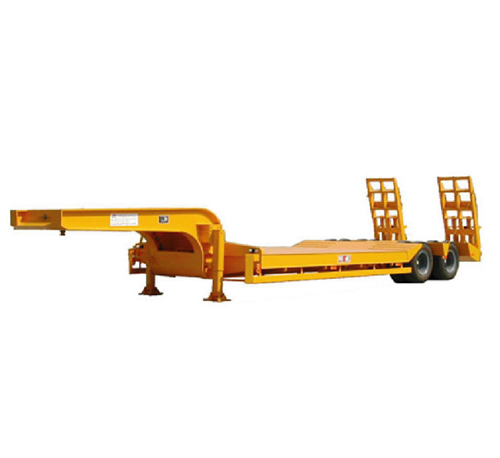
Fixed Gooseneck
A fixed-gooseneck design is structurally straightforward and can be suitable when machinery is loaded using rear ramps or when cranes are available.
Its simplicity can also reduce the number of hydraulic or detachable components requiring maintenance.
Detachable Gooseneck
A detachable or removable gooseneck allows the front section of the trailer to separate so that self-propelled machinery can approach the main deck from the front.
This can reduce loading angle and make it easier to move certain excavators, loaders, and other machines onto the trailer.
Which One Should a Buyer Choose?
Choose according to the daily operating process.
A construction fleet frequently moving crawler equipment may value easier drive-on loading. A project logistics company that frequently uses cranes may place greater priority on structural simplicity.
The best design is the one that reduces loading difficulty without adding unnecessary equipment or cost.
How Ramp Design Affects Heavy Equipment Loading
Ramps are often treated as a minor accessory during procurement, but they have a direct impact on daily efficiency.
Ramp Length
Longer ramps generally create a gentler loading angle.
This can be important for machinery with limited ground clearance or a long wheelbase.
Ramp Width
Ramp width should match the track or tire positions of the machinery.
A narrow ramp may make loading more difficult and place greater demands on operator accuracy.
Mechanical vs Hydraulic Ramps
Mechanical ramps are relatively simple and can be suitable for fleets prioritizing straightforward maintenance.
Hydraulic ramps can reduce manual effort and improve loading convenience, particularly where machines are loaded frequently.
The better option depends on loading frequency, maintenance capability, operating environment, and budget.
Mechanical Suspension vs Air Suspension
Suspension choice should reflect the roads the trailer will actually use.
Mechanical Suspension
Mechanical suspension is widely used in heavy-duty applications because of its relatively simple construction and suitability for demanding environments.
It may be attractive for mining areas, construction sites, developing markets, or fleets where simple maintenance is important.
Air Suspension
Air suspension can provide improved ride characteristics and better protection for certain types of cargo.
It may be preferred for highway-oriented operations or situations where ride quality is more important.
Consider Spare Parts Availability
The best suspension specification is not always the most sophisticated one.
For international buyers, local access to suspension components, brake parts, bearings, tires, and axle service should be considered before selecting a configuration.
A technically advanced system can become inconvenient if replacement components are difficult to obtain locally.
Why Main Beam and Deck Construction Matter
Heavy equipment does not distribute weight in the same way as palletized cargo.
A crawler excavator or bulldozer can create significant concentrated loads through tracks and contact points.
For that reason, buyers should evaluate more than total payload.
Main Beam
The main beam carries a large portion of the structural load.
Material grade, beam dimensions, reinforcement, welding quality, and structural design all affect long-term performance.
Simply asking for “thicker steel” is not enough. Excess material can add unnecessary dead weight without improving the design efficiently.
Cross Members
Cross members support the deck and help distribute localized loads.
Their spacing and reinforcement should correspond to the machinery that will regularly operate on the loading platform.
Loading Area Reinforcement
When tracked equipment is transported frequently, the manufacturer should understand where the tracks will sit and where concentrated stresses will occur.
A properly designed trailer places reinforcement where it is structurally useful instead of increasing steel thickness everywhere.
Match the Trailer to the Tractor Truck
A lowbed semi trailer should never be specified without considering the tractor.
Important tractor information includes:
- tractor model;
- drive configuration;
- fifth-wheel height;
- fifth-wheel load;
- engine power;
- wheelbase;
- braking system;
- electrical connection;
- intended gross combination weight.
Why Fifth-Wheel Height Is Important
The tractor’s fifth-wheel height affects the actual operating angle and height of the trailer.
This means the same lowbed trailer connected to two different tractors may not have exactly the same loaded geometry.
Providing tractor information during the quotation stage allows the manufacturer to evaluate compatibility before production.
Heavy Equipment Securement Should Influence Trailer Design
Tie-down points should be considered during trailer specification rather than treated as an afterthought.
Construction machinery may require chains, binders, blocking, locking devices, or other securement methods depending on the machine and destination regulations.
In the United States, FMCSA has specific cargo-securement requirements for heavy vehicles, equipment, and machinery weighing 4,536 kg (10,000 lb) or more. Buyers operating in other countries should verify the regulations that apply in their own markets.
Tie-Down Point Position
Tie-down locations should correspond to the equipment being transported.
Poorly positioned anchor points can make effective securement difficult even when the trailer itself has sufficient structural capacity.
Accessories Must Also Be Considered
Buckets, blades, booms, and other equipment attachments may require locking or additional securement depending on their design and applicable regulations. FMCSA guidance, for example, addresses how accessories on heavy construction equipment should be restrained during transport.
Lowbed Semi Trailer Specification Checklist
Before requesting a quotation, prepare the following information.
| Information | What to Provide |
|---|---|
| Cargo type | Excavator, bulldozer, loader, etc. |
| Maximum cargo weight | Actual transport weight |
| Cargo length | Overall transport length |
| Cargo width | Maximum transport width |
| Cargo height | Height in transport condition |
| Required payload | Based on actual machinery |
| Axle preference | If local regulations require it |
| Road condition | Highway, construction site, mining road |
| Loading method | Rear ramp, front loading, crane |
| Tractor model | Including fifth-wheel information |
| Suspension preference | Mechanical or air |
| Tire requirements | Size and local availability |
| Destination country | For regulatory consideration |
| Optional features | Hydraulic ramps, widening deck, tool box, etc. |
What Should You Send a Manufacturer First?
For faster quotation, send the machine model or specification sheet together with:
- Equipment weight
- Length
- Width
- Height
- Photos if available
- Destination country
- Tractor information
- Expected operating conditions
This gives the manufacturer much more useful information than simply asking for the price of a “standard lowbed trailer.”
Common Lowbed Semi Trailer Buying Mistakes
Choosing Capacity Only by Tonnage
A 60-ton requirement does not provide enough information to engineer a suitable trailer.
Dimensions, center of gravity, concentrated loads, axle distribution, and road regulations also matter.
Ignoring Trailer Tare Weight
Adding more steel can increase dead weight.
A stronger design should use structural engineering rather than simply making every component heavier.
Buying Too Close to Current Requirements
A trailer selected only for today’s smallest machine may become unsuitable when the fleet expands.
Consider the machinery the business expects to transport over the next several years.
Ignoring Local Parts Support
Axles, brake components, suspension parts, tires, and bearings should be practical to maintain in the destination market.
Comparing Quotations Without Comparing Specifications
Two lowbed trailer quotations may appear similar while using different:
- axle brands;
- tire specifications;
- steel grades;
- suspension systems;
- beam structures;
- ramp designs;
- braking systems;
- reinforcement methods.
Price comparison only makes sense after the technical configuration has been aligned.
When Does a Customized Lowbed Semi Trailer Make Sense?
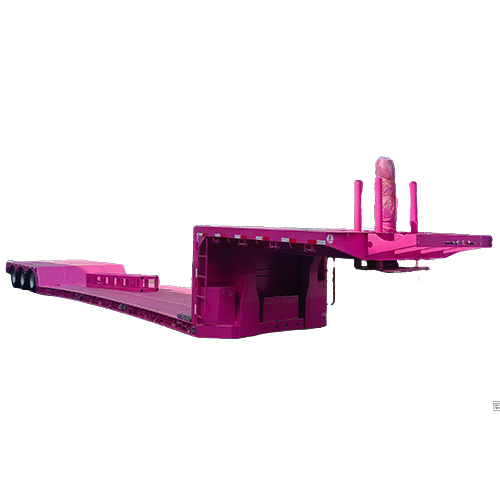
Standardized models work well for many applications, but customization becomes valuable when the cargo or operating environment is unusual.
A customized lowbed semi trailer may be appropriate when:
- the machine is especially wide;
- the equipment is unusually tall;
- concentrated track loads are high;
- road conditions are poor;
- loading frequency is high;
- a specific tractor must be matched;
- local axle limits require a different configuration;
- hydraulic loading systems are needed;
- multiple machinery types must share one trailer.
Shandong Haiyu provides semi-trailer configurations based on load requirements, working conditions, and destination-market requirements, making detailed equipment information important during the quotation stage.
FAQ About Lowbed Semi Trailer Specifications
What size lowbed semi trailer do I need for an excavator?
Start with the excavator’s transport weight, overall length, track width, and total height. These dimensions help determine deck length, width, payload, axle configuration, and loading method.
Is a 3-axle lowbed semi trailer enough for heavy equipment?
It can be suitable for many construction machines, but axle quantity alone does not determine capacity. Actual cargo weight, axle ratings, axle spacing, tires, suspension, trailer structure, and local road limits must also be checked.
Is a lowbed trailer better than a flatbed for excavators?
For many excavators, yes. The lower deck helps reduce total transport height and center of gravity, while ramp or detachable-gooseneck configurations can make machinery loading easier.
Should I choose mechanical or air suspension?
Mechanical suspension is often attractive for demanding roads and simpler maintenance, while air suspension may be preferred for highway operations and improved ride characteristics. Local service capability should also influence the decision.
How many tons can a lowbed semi trailer carry?
Capacity varies significantly by structure and configuration. Instead of selecting only by a nominal tonnage, provide the manufacturer with the actual machine weight and dimensions so the complete trailer specification can be evaluated.
What information is needed to get an accurate lowbed trailer quotation?
At minimum, provide cargo type, maximum weight, length, width, height, destination country, road conditions, loading method, and tractor information.
Can a lowbed trailer be customized for different excavators?
Yes. Deck dimensions, axle quantity, suspension, ramps, reinforcement, tires, and other components can be configured around the equipment and operating conditions.
What should I inspect before ordering a lowbed semi trailer?
Check the main beam design, cross-member structure, axle and suspension specifications, brakes, tires, welding quality, loading ramps, tie-down points, electrical system, and whether the complete configuration matches your cargo.
Conclusion
Selecting the right lowbed semi trailer requires much more than comparing payload numbers.
The best specification starts with the machinery: its actual transport weight, dimensions, loading method, and working environment. From there, buyers can determine suitable deck dimensions, axle configuration, suspension, ramp design, reinforcement, and tractor compatibility.
For B2B buyers, the most effective approach is to provide complete cargo and operating information before requesting a final quotation. This allows the trailer to be configured around real transport requirements rather than a generic tonnage label.
A correctly matched lowbed semi trailer can improve loading efficiency, reduce operational limitations, support safer equipment transport, and provide greater flexibility as a fleet’s machinery requirements change.